403-266-2283
1918 Kensington Rd NW Unit #310, Calgary, AB T2N 3R5, Canada

Who This Blog Is For: Anyone in Calgary — from the inner-city neighbourhoods of Inglewood and Capitol Hill to the growing communities of Evanston and Nolan Hill in the northwest — who has spent years managing neck tension and migraines as two separate problems, quietly noticing that one almost always precedes or accompanies the other. This is for the person who has mentioned the neck pain and migraines connection to providers before and received a partial answer — or no answer at all. If the structural relationship between those two experiences has never been formally explored, what follows may reframe something you've suspected for a long time.
Does your neck always tighten before a migraine arrives — so reliably that you've started treating it as a warning sign? Have you ever wondered whether the tension you carry between your shoulders and the base of your skull and the headaches that follow are actually the same problem expressing itself in two different ways? Have you been managing both for so long that it no longer occurs to you that the pattern itself might have an explanation?
These are the questions we hear most consistently from Calgary patients who come to Vibe Health having addressed their neck pain and their migraines separately for years — physiotherapy for one, medication for the other — without either ever fully resolving. The connection they've sensed all along turns out, in many cases, to have a clear structural basis. And that basis is something upper cervical care is specifically positioned to assess.
Table of Contents
Neck pain and migraines co-occur so frequently that researchers have long recognized the cervical spine as a meaningful contributor to migraine activity — not merely a coincidental companion. For patients who consistently experience neck stiffness or tension before or during a migraine episode, that sequence reflects a shared neurological and structural origin rather than two unrelated conditions happening to overlap.
The upper cervical spine is where that origin most commonly lives.
When the atlas shifts out of its optimal position, the body compensates throughout the postural chain to keep the head level. That compensation creates chronic asymmetrical tension through the suboccipital muscles — the deep muscles at the base of the skull — alters nerve signaling through the upper cervical region, and influences the vascular dynamics that play a recognized role in migraine development. The neck tightens because the structure is compensating. The migraine follows because that same compensation has lowered the neurological threshold for an episode to occur. The two symptoms are not independent events. They are two expressions of one structural pattern.
We want to be specific about this, because it's a connection most patients have never had explained clearly. The atlas sits at the craniocervical junction — the point where the skull meets the spine — in close proximity to the nerve roots, vascular structures, and muscular attachments that are directly relevant to both cervical tension and migraine physiology.
When the atlas misaligns, even subtly, the muscles on one side of the neck and skull work harder than the other to maintain head stability. That chronic asymmetrical load creates a state of persistent tension through the suboccipital region that many patients experience as a low-grade tightness they've simply learned to live with. Over time that baseline tension, combined with the altered nerve signaling patterns the compensation produces, creates a nervous system that is chronically closer to the migraine threshold than it should be.
Calgary's significant barometric pressure swings are a well-recognized migraine trigger in this region. A structurally compromised upper cervical spine may make the nervous system considerably more reactive to those pressure changes, meaning the same weather event that passes without consequence for one person triggers a full migraine episode for another. The trigger isn't always the problem. The structural vulnerability underneath it frequently is.
When you are dealing with a structural misalignment at the very top of your spine, correcting it requires a specialized approach. That is where upper cervical chiropractic care comes in.
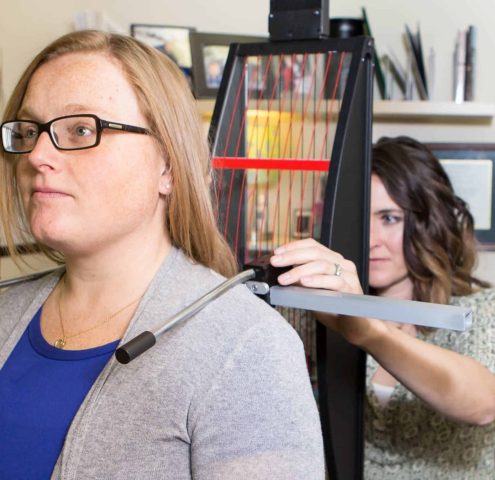
Specifically, NUCCA is a precise, measurement-guided technique that focuses entirely on the atlas—the top vertebra—and its relationship to your skull and cervical spine. Because this area is so critical, the process begins with detailed, specialized imaging. Before any correction is made, we assess the exact position of the atlas, mapping out the precise degree of misalignment and the structural compensation patterns it has created throughout your body.
For patients presenting with both neck pain and migraines, this imaging often tells a story that neither condition's previous care had access to. The correction itself is gentle — no cracking, no forceful manipulation, no rotation of the neck. It is applied by hand to the atlas with a specificity that requires careful analysis of the imaging and advanced clinical training.
At Vibe Health and Spine, nothing is adjusted on the first visit until the structural picture has been fully reviewed. The process is methodical by design — because precision at this level of the spine requires it.
If you've spent years treating your neck pain in one room and your migraines in another, and neither has fully resolved, the most important question may be the one that hasn't been asked yet: is there a single structural origin driving both?
At Vibe Health in Calgary, that's exactly the question the assessment process is designed to answer. A thorough consultation, precise upper cervical imaging, and a clear conversation about what the findings mean for your specific pattern — that's where it starts. No adjustments are made until the picture is complete.
Calgary winters are demanding enough. The combination of neck tension and migraines that follows you through all of it doesn't have to be the baseline you accept.
Schedule your consultation at Vibe Health and Spine today.
The first step is a conversation — and it costs you nothing to find out whether the structural connection has been the missing piece all along.

1. Why does my neck always tighten before a migraine — is that significant?
It's one of the most telling patterns we see, and yes — it is significant. When neck tension reliably precedes a migraine, it strongly suggests the two share a structural origin rather than occurring independently. The suboccipital muscles at the base of the skull are among the first to reflect atlas compensation, and that tension is frequently an early signal that the neurological threshold for a migraine episode is being approached. It's worth investigating structurally.
2. I've had both neck pain and migraines for over a decade. Would upper cervical care still be relevant?
Duration alone doesn't determine whether upper cervical care is appropriate — the presence of atlas misalignment does. Patients with long-standing patterns involving both conditions who have never had their upper cervical spine formally assessed frequently find that the structural picture offers a perspective their previous care simply didn't have access to. The assessment at Vibe Health is where that determination is made.
3. Could one atlas adjustment resolve both my neck pain and my migraines?
Upper cervical care rarely works in a single correction — and we'd be doing you a disservice to suggest otherwise. What NUCCA care at Vibe Health aims to do is restore the structural foundation progressively, with each visit informed by precise imaging and reassessment. As the atlas stabilizes and the compensation pattern resolves, both conditions typically respond — but the timeline varies meaningfully from patient to patient depending on how long the pattern has been present and how the individual's structure responds.
4. My neck pain is mostly on one side — does that change the upper cervical assessment?
One-sided neck pain is actually a common presentation in patients with atlas misalignment, because the compensation pattern the atlas creates is inherently asymmetrical — the muscles on one side work harder than the other. That unilateral pattern is worth noting when you come in, and the imaging process at Vibe Health will assess specifically what the atlas position looks like and how it relates to the tension distribution you're experiencing.
5. I've been told my migraines are hormonal. Could there still be a cervical component?
Yes — and the two are not mutually exclusive. Hormonal fluctuations are a recognized migraine trigger, and for many patients they are genuinely part of the picture. What upper cervical care addresses is the structural vulnerability that may be making the nervous system more reactive to those hormonal shifts. Reducing that underlying sensitivity doesn't eliminate hormonal influences, but it may meaningfully raise the threshold at which those influences trigger a full episode.
To schedule a consultation with Vibe Health and Spine, call our Calgary office at 587-803-3354. You can also click the button below.

If you are outside of the local area you can find an Upper Cervical Doctor near you at www.uppercervicalawareness.com.