403-266-2283
1918 Kensington Rd NW Unit #310, Calgary, AB T2N 3R5, Canada

Who This Blog Is For: Anyone in Calgary — from the downtown core to Beltline, Bridgeland, and the growing communities out in Mahogany and Sage Hill — who has been chasing TMJ pain relief for months or years and still wakes up with a tight jaw, a dull ache behind the ear, or a click that never quite went away. This is for the person who has already done the responsible thing — seen the right providers, tried the recommended approaches — and is still wondering why the pattern keeps returning.
Does your jaw feel locked up before you've even had your first coffee? Do you find yourself clenching through back-to-back meetings, only to pay for it by evening with a headache that wraps from your jaw up into your temple? Have you wondered, quietly, whether something more fundamental is being missed?
These are the questions we hear most often from Calgary patients who arrive at Vibe Health after a long road of partial answers. TMJ pain has a way of being present enough to affect your daily life — your sleep, your focus, your ability to eat comfortably — but elusive enough that it rarely gets fully resolved. If that sounds familiar, what follows may offer a perspective you haven't encountered yet.
Table of Contents
TMJ pain relief refers to a lasting reduction in jaw pain, tension, clicking, and the associated symptoms — headaches, ear fullness, facial aching — that make this condition so disruptive. For many people, genuine relief remains frustratingly out of reach because the approaches they've tried address the jaw itself without examining what may be driving the jaw into that dysfunctional pattern in the first place.
That missing piece, for a significant number of patients, lives at the very top of the spine.
The temporomandibular joint sits in close structural relationship with the upper cervical spine. When the atlas — the first cervical vertebra — shifts out of its optimal position, the body compensates throughout the entire postural chain to keep the head level. That compensation creates uneven muscular tension, altered nerve signaling, and asymmetrical loading across the jaw joint. The jaw doesn't malfunction in isolation. It responds to what the rest of the structure is doing — and if the foundation is off, the jaw often bears the consequences.
We want to be honest about something that doesn't always come up in a standard TMJ conversation: the jaw joint and the upper cervical spine share both anatomical proximity and neurological territory. When the atlas shifts — even subtly — the compensation pattern that follows can alter the muscular balance on one side of the face and jaw, change the tension through the muscles that control mouth opening and closing, and create a cascade of pressure that the TMJ absorbs chronically.
This is not a fringe idea. It's a structural reality that upper cervical practitioners assess routinely. Calgary patients who come in describing years of jaw clicking, morning tightness, or one-sided facial aching frequently present with measurable atlas misalignment that has never been part of their TMJ conversation — not because their previous providers missed something important, but because the upper cervical spine simply isn't part of a standard dental or physiotherapy assessment.
The compensation pattern — not the joint itself — is often where the answer lives.
Night guards, occlusal splints, and jaw physiotherapy are legitimate, well-intentioned approaches — and for many people they provide meaningful symptom management. We have enormous respect for the providers who offer them. The limitation isn't the quality of the care. It's the scope.
When jaw-focused care addresses the joint without examining the structural environment the joint is operating in, it's working on the effect rather than the contributing pattern. The jaw gets some relief. The underlying compensation continues. Symptoms return — sometimes gradually, sometimes quickly — and the cycle begins again.
This is the pattern that brings many Calgary patients to upper cervical care after years of managing but never fully resolving. They haven't failed their previous care. Their previous care simply didn't have the full picture.
NUCCA is a precise, measurement-guided approach within upper cervical care that uses detailed imaging to assess the position of the atlas before any correction is made. There are no forceful adjustments. The correction itself is gentle — applied by hand to the atlas with a specificity that requires advanced training and careful analysis.
For TMJ patients, the goal is not to adjust the jaw. It's to restore the structural foundation that the jaw depends on. When the atlas returns to a more optimal position, the compensation pattern throughout the spine and musculature begins to shift. Muscle tension that has been chronically asymmetrical starts to normalize. The load on the jaw joint changes.
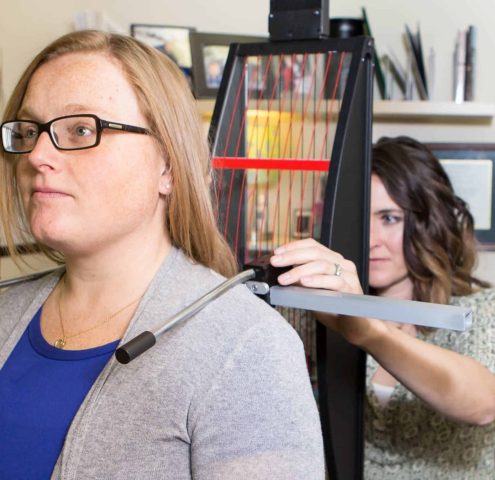
Several imaging assessments are involved in the process at Vibe Health — the team works from measurements, not guesswork, and every correction is informed by what the imaging shows. Patients new to this approach often remark that it's unlike anything they've experienced — quieter, more methodical, and more focused on precision than force.
We find this part meaningful to share, because it often surprises people. TMJ pain relief through upper cervical care rarely happens all at once — and that's actually a sign the process is working as it should. The jaw has been operating in a compensated pattern, in many cases, for years. As the atlas stabilizes and the postural chain begins to reorganize, patients frequently notice changes in layers.
Morning jaw tightness often eases before the clicking does. Sleep quality frequently improves earlier than expected — likely because the muscular tension driving nighttime clenching begins to reduce. Headaches that were assumed to be tension-related often become less frequent as the upper cervical region stabilizes.
Calgary's long winters and high-pressure work culture create conditions where clenching and jaw tension run chronically high. When the structural foundation shifts, many patients find that the daily load their jaw has been carrying quietly starts to feel lighter — and that the good days begin to outnumber the difficult ones.
There's a particular kind of exhaustion that comes with a problem you've addressed responsibly and still can't fully resolve. You've shown up. You've done the work. You've tried what made sense. And on the mornings when your jaw is already aching before the day has started, it's reasonable to wonder whether something in the picture has simply been missed.
At Vibe Health in Calgary, we work with patients who are exactly at that point — not as a last resort, but as a next step that brings a different lens to a problem they've been carrying for too long. If the structural foundation of your upper cervical spine has never been assessed in the context of your TMJ symptoms, that assessment is where we start.
Calgary winters are hard enough without waking up in jaw pain. The cycle you've been managing doesn't have to be permanent.
Schedule your consultation at Vibe Health and Spine today.
The first step is a conversation — and it costs you nothing to find out whether this is the piece that's been missing.

1. Can jaw pain really be connected to the top of my spine?
More often than most people realize. The atlas — the first bone in your cervical spine — sits in close structural proximity to the jaw joint and shares neurological territory with the muscles that control jaw movement. When the atlas shifts out of alignment, the compensation pattern that follows can create chronic asymmetrical tension across the jaw. It's a connection that doesn't show up in a standard dental X-ray, which is why it often goes unexamined for years.
2. My TMJ symptoms are mostly clicking and occasional aching — is that enough to warrant an upper cervical assessment?
Yes, and in many cases those are exactly the early signals worth paying attention to. Clicking often reflects asymmetrical loading on the jaw joint — one side working harder than the other over time. An upper cervical assessment looks at whether a structural compensation pattern may be contributing to that imbalance, before it progresses into more significant dysfunction.
3. How is the NUCCA correction different from a standard chiropractic adjustment?
NUCCA is a highly specific, measurement-guided approach focused exclusively on the atlas. Corrections are gentle — there is no cracking, twisting, or forceful manipulation involved. Everything is guided by detailed imaging taken before any correction is made. Patients frequently describe the experience as surprisingly subtle, especially compared to what they expected.
4. I've had TMJ symptoms for several years. Is upper cervical care still worth exploring?
Duration alone doesn't determine whether upper cervical care is appropriate — the presence of an atlas misalignment does. Patients with long-standing TMJ symptoms who have never had their upper cervical spine assessed often find that the structural picture tells a story their previous care didn't have access to. The assessment at Vibe Health is where that conversation begins.
5. Will my jaw be adjusted directly during NUCCA care?
No. NUCCA care focuses on the atlas — the structural foundation — not the jaw joint itself. The premise is that when the foundation is restored to a more optimal position, the compensation patterns driving jaw dysfunction have the opportunity to shift. The jaw is not manipulated directly at any point in this process.
6. What should I expect at my first visit to Vibe Health for TMJ concerns?
Your first visit begins with a thorough consultation — the team wants to understand your full symptom history, what you've already tried, and what your experience of this condition has actually been like day to day. From there, specific imaging is taken to assess the position of the atlas. Nothing is adjusted on the first visit until the measurements have been reviewed and a clear picture of your structural situation is established.
To schedule a consultation with Vibe Health and Spine, call our Calgary office at 587-803-3354. You can also click the button below.

If you are outside of the local area you can find an Upper Cervical Doctor near you at www.uppercervicalawareness.com.