403-266-2283
1918 Kensington Rd NW Unit #310, Calgary, AB T2N 3R5, Canada

Who This Blog Is For: Anyone in Calgary — from the downtown core and East Village to the suburban office parks of Quarry Park and Remington — who has started to notice that vertigo episodes seem to cluster around long screen sessions. If the connection between screen time and vertigo has never been part of your care conversation, this blog is for you.
Have you noticed that your vertigo seems worse after long days at the screen — or that the dizziness tends to hit hardest in the evenings after a day of meetings and focused work? Have you adjusted your monitor, your chair, your posture — and still found the pattern unchanged? Have you ever wondered whether the neck tension you carry through every screen session and the spinning episodes that follow are more structurally connected than anyone has formally acknowledged?
These are the questions we hear consistently from Calgary professionals who arrive at Vibe Health and Spine having managed a vertigo pattern for months or years without the postural and structural dimensions ever entering the conversation. Screen time and vertigo are rarely discussed together in a clinical context — but for a significant number of patients, the connection is both real and structurally specific.
Table of Contents
Quick Answer: Screen time and vertigo are connected through posture. Extended screen use pulls the head forward, increasing mechanical load on the atlas. When the atlas is already misaligned, that added postural stress disrupts the vestibular and proprioceptive signals the nervous system uses for balance and spatial orientation. The result is a vertigo pattern that worsens with screen exposure — not because of the screen itself, but because of what prolonged screen posture does to an already compromised structural foundation.
The vestibular system — the network responsible for balance and spatial orientation — depends heavily on accurate signaling from the upper cervical spine. The atlas and the structures surrounding it are densely populated with proprioceptive receptors that continuously feed positional information to the brain. When the atlas misaligns and that signaling becomes disrupted or inconsistent, the brain receives conflicting messages about where the body is in space — and vertigo is frequently the result.
Screen time enters this picture through posture. Every hour spent looking at a screen tends to draw the head forward relative to the shoulders — a pattern so common in Calgary's desk-heavy workforce that it has become effectively baseline for a large portion of the population. For someone whose atlas is already positioned sub-optimally, that forward head carriage adds a compounding mechanical load that worsens the structural stress and amplifies the vestibular disruption already present. The screen doesn't create the vulnerability. It reliably aggravates it.
The mechanical math here is worth understanding clearly. For every inch the head moves forward from its neutral position over the shoulders, the effective weight the cervical spine must support increases significantly.
In a standard forward screen posture — head two to three inches forward, chin slightly elevated toward the monitor — the load on the upper cervical structures can be several times the neutral baseline.
For a patient with atlas misalignment, that load doesn't distribute evenly. The compensation pattern the atlas has already created means certain muscles and joints are absorbing disproportionate stress — and the proprioceptive receptors embedded in those structures are firing in a pattern that reflects that asymmetry.
The brain receives vestibular input that is chronically inconsistent with what the eyes and inner ear are reporting, and the result is the dizziness and spatial disorientation that vertigo patients describe.
Long exposure to screens — compounded by remote work arrangements that have removed the natural postural breaks a commute and office environment once provided — mean this loading pattern runs for longer, with less interruption, than at any previous point. The atlas compensation that might have been manageable with a shorter workday becomes significantly more symptomatic when screen exposure extends to eight, ten, or twelve hours.
Ergonomic interventions — monitor positioning, sit-stand desks, screen time limits, postural reminders — are sensible and worth maintaining. They reduce the acute postural load in the moment. What they don't address is the underlying atlas misalignment that the posture has been aggravating.
When the structural foundation is compromised, reducing the aggravating factor provides partial and temporary relief. The atlas remains in its misaligned position. The vestibular disruption it produces continues at a lower baseline. The vertigo pattern eases somewhat — enough to be encouraging — and then returns whenever screen demands increase, fatigue accumulates, or Calgary's Chinook pressure shifts add their own vestibular load to an already sensitized system.
This is the pattern that brings many Calgary professionals to Vibe Health and Spine. They've done the ergonomic work responsibly and found the ceiling it reaches. The structural layer has simply never been part of the solution.
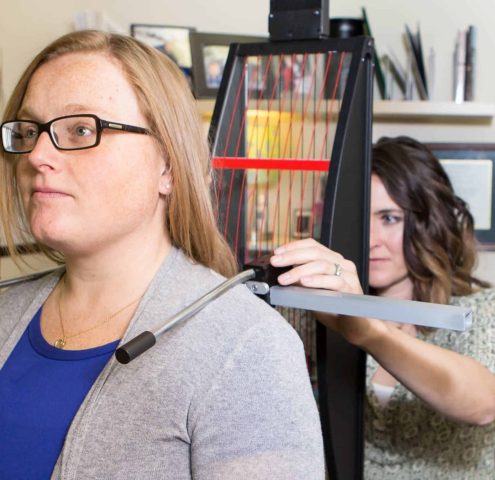
NUCCA care begins with detailed imaging of the upper cervical spine — the position of the atlas, its relationship to the skull and the vertebra below, and the compensation pattern it has created. For vertigo patients, this imaging is particularly relevant because the vestibular disruption being experienced is directly tied to the precision of what happens next.
The correction is gentle — applied by hand to the atlas with no cracking, no forceful manipulation, no rotation of the neck. The specificity of the adjustment is guided entirely by the imaging, and nothing is corrected on the first visit until the structural picture has been fully reviewed and discussed. For patients who have been managing vertigo episodes cautiously — aware that the wrong movement can trigger an episode — that methodical, measurement-guided approach is consistently described as reassuring.
At Vibe Health and Spine, the process is designed to restore the structural foundation with precision rather than force, allowing the vestibular system to begin recalibrating from a more stable structural base.
The shift vertigo patients describe as the atlas stabilizes tends to follow a recognizable sequence. The episodes that were clustering around long screen days begin to space further apart before they become less severe. The neck tension that had become the reliable precursor to a dizzy spell starts to ease — not dramatically, but measurably. The end-of-day dizziness that had become part of the professional routine begins to show up less consistently.
For Calgary professionals navigating demanding screen environments, that shift often registers in practical terms first — getting through a full day of meetings without managing the edges of a vertigo episode, standing up from the desk without the moment of spatial uncertainty that had become habitual. The screen time and vertigo pattern that felt like a fixed feature of the workday starts to feel like something that can actually be addressed at its structural source.
If you've been quietly working around vertigo episodes for months or years — adjusting your screen setup, timing your movements carefully, managing the pattern without ever fully resolving it — the most important question may be one that hasn't been formally asked yet: is there a structural foundation issue that no one has assessed?
At Vibe Health and Spine in Calgary, that is exactly where the conversation begins. A thorough consultation covering your vertigo history, your screen environment, and what you've already tried. Precise upper cervical imaging to assess the atlas position. An honest conversation about what the structural findings mean for your specific pattern — before anything is adjusted.
Calgary's screen demands aren't going away. The vertigo pattern that has been following you through them doesn't have to be permanent.
Schedule your consultation at Vibe Health and Spine today.

1. I only get vertigo after long screen sessions — does that pattern point to something structural?
That timing is one of the more telling patterns we see. When vertigo episodes cluster reliably around extended screen use, it strongly suggests that forward head posture is aggravating an underlying structural vulnerability rather than causing vertigo independently. An upper cervical assessment at Vibe Health and Spine examines specifically whether atlas misalignment is the structural piece that screen posture has been loading — and whether addressing it changes the pattern.
2. I've tried ergonomic adjustments and they help a little but the vertigo always comes back — why?
Ergonomic changes reduce the postural load in the moment but don't reach the underlying atlas misalignment that the posture has been aggravating. When the structural foundation remains unaddressed, relief from ergonomic interventions tends to be partial and temporary — enough to be encouraging, not enough to break the cycle. Upper cervical care at Vibe Health and Spine addresses the layer that ergonomics was never designed to reach.
3. My vertigo episodes are brief but happen multiple times a day during heavy screen periods — is that significant?
Frequency matters, and multiple daily episodes during high screen periods suggests the vestibular disruption is closely tied to the postural load those sessions are creating. Brief but frequent episodes are often more structurally informative than occasional severe ones — they indicate a system that is consistently close to its threshold. An upper cervical assessment is a direct way to determine whether atlas misalignment is the structural driver of that threshold sensitivity.
4. I work from home and my screen time has increased significantly — could that explain why my vertigo has gotten worse recently?
Yes — and this is a pattern we see frequently among Calgary's remote workforce. Extended home screen environments typically involve longer continuous sessions, less natural postural variation, and fewer built-in breaks than office settings. For someone with an existing atlas misalignment, that increased and less-interrupted postural load can meaningfully worsen the vestibular disruption the structural compromise was already producing. The timing of the worsening is relevant information for the assessment.
5. I also get neck tension before my vertigo episodes — does that change anything about the upper cervical assessment?
It adds relevant information rather than changing the assessment. Neck tension that reliably precedes vertigo is frequently an early signal of the same structural compensation pattern driving both symptoms — the suboccipital muscles reflecting atlas stress before the vestibular disruption reaches the threshold for a full episode. That sequence is worth describing in detail during your consultation at Vibe Health and Spine.
To schedule a consultation with Vibe Health and Spine, call our Calgary office at 587-803-3354. You can also click the button below.

If you are outside of the local area you can find an Upper Cervical Doctor near you at www.uppercervicalawareness.com.