403-266-2283
1918 Kensington Rd NW Unit #310, Calgary, AB T2N 3R5, Canada

Who This Blog Is For: You have already answered this one for yourself. Is back pain a normal part of aging? You decided yes and got on with things. Now you stretch before getting out of bed, take the parkade stairs slower, and think twice about the second run. This blog is for adults across Hillhurst, Sunnyside, Briar Hill, Parkdale, Montgomery, and Bowness who have not slowed down and are quietly paying for it longer than they used to.
The weekend still happens. You ski, you ride the pathway along the Bow, you spend Saturday on a project in the garage. What is different is Monday — and Tuesday. Soreness that once cleared overnight now takes three days, in the same spot every time. How you move has not changed. What it costs you has.
Table of Contents
Quick Answer: Back pain becomes more common with age, but age alone is rarely the full explanation. Your family doctor evaluates recognized causes such as disc degeneration, facet or spinal osteoarthritis, stenosis, and bone density changes. A commonly overlooked contributor is postural asymmetry originating at the upper neck, which can load one side of your lower back unevenly for decades.
Age is a real factor. Discs lose water content, joint surfaces change, bone density shifts, and tissues take longer to recover. What is worth questioning is the leap from "age is a factor" to "age is the explanation" — different claims, and only the first is well supported.
Your family doctor looks first at the recognized causes: degenerative disc changes, osteoarthritis in the facet joints, spinal stenosis, disc herniation, and bone density loss that can leave a vertebra vulnerable. These are real conditions with real management paths, and they belong in a medical workup.
Everyday moments are the spark, not the cause. Standing up after the drive back from Kananaskis, lifting a ski bag out of the trunk, the first shovel of the season — these set off an episode. They do not explain why the same spot keeps taking the hit.
If age were the whole answer, you would feel it evenly — both sides, in proportion to the years. For a lot of people it does not work that way. It concentrates. One side. One spot. The same one, every time.
That asymmetry is the clue, and it usually starts higher up than the lower back. The top of your spine has one job that outranks the others: keeping your head level. When the upper cervical vertebrae sit slightly off-centre, the rest of the frame adjusts to protect that. One shoulder settles lower. The pelvis rotates a few degrees. One leg functions as though it were slightly shorter — none of it dramatic, none of it visible in a mirror.
But your lower back is no longer loading evenly. One side absorbs more with every step, every lift, every hour at the kitchen counter. Over a decade, that small difference is measured in millions of repetitions. This is one reason back pain without an injury is so common after fifty: no single moment to point to, only a pattern running quietly for a very long time.
What changes at fifty-five is not the pattern. Most people have carried theirs since an old fall or a car accident decades ago. At thirty, tissue recovers quickly enough that uneven loading never surfaces. Over the years that window narrows. The loading has not worsened — it has become something you can feel.
Some back pain needs a medical assessment first. See your family doctor promptly if a stable pattern changes suddenly, if pain wakes you at night, if there is new weakness or numbness in a leg, if bladder or bowel function changes, or if morning stiffness lasts well past waking — the last can point toward inflammatory conditions such as axial spondyloarthritis. This is a prompt to get seen, not a checklist for clearing yourself.
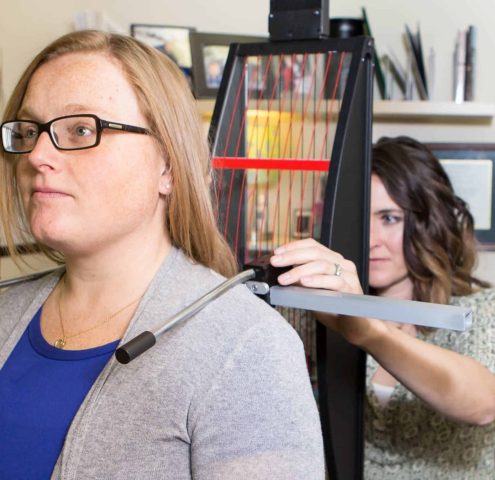
Upper cervical care looks narrowly at the alignment of the top of the neck and how the rest of your posture organizes around it. At Vibe Health & Spine, our team uses NUCCA — an imaging-guided approach that measures the position of the upper cervical spine in three dimensions before any correction is made.
That measurement matters more than it sounds. The correction is calculated for your anatomy rather than applied generically, and there is a before and after to compare against. Corrections are gentle and low-force, without twisting or sudden movement.
The aim is not to chase the sore spot but to give your frame a more even starting point, so a decades-old loading pattern has a reason to change. Working with a back pain chiropractor in Calgary AB fits alongside the medical care you already receive — and a wait for a referral or imaging is a useful window for examining the structural side of back pain and aging.
If your back has been sore for years and "getting older" is the only explanation offered, that is worth a second look — not because it is wrong, but because it may be incomplete. An upper cervical evaluation examines what a standard workup is not built to check: whether your frame has been loading unevenly long enough that you have started to feel it. At Vibe Health & Spine on Kensington Road NW, our team offers a gentle evaluation to see whether alignment is part of your picture.
I'm in my fifties and my back hurts most days. Is that just my age?
Age is part of the picture, but it is rarely the whole one. Discomfort that settles into the same place tends to point toward a loading pattern rather than general wear. It is worth having both the medical and the structural sides looked at rather than assuming one explanation covers everything.
Can the upper neck really affect the lower back?
It can contribute. The upper cervical spine influences how your head sits over your shoulders, and the rest of your frame organizes itself beneath that. When the top is off-centre, the pelvis and lower back take on a compensating position, which changes how weight is distributed with every step.
What causes back pain without an injury?
Often there was no single event because the pattern developed gradually. Cumulative uneven loading, long-standing postural asymmetry, and age-related tissue changes can combine over years. Your family doctor can rule out the recognized medical causes, and a structural evaluation examines the loading side of the picture.
Does upper cervical care replace seeing my family doctor?
No. Your doctor evaluates and manages conditions like disc degeneration, arthritis, and stenosis, and that work is important. Upper cervical care examines something different — how your structure is organized and loaded — which is a perspective a standard workup is not designed to cover.
I was in a car accident thirty years ago. Could that still matter?
It may be worth examining. An impact can leave a small change in upper cervical alignment that the body compensates around, and compensation can hold for decades without discomfort. That history is one of the more useful things to bring to an evaluation.
Is this gentle enough if I already have arthritis in my spine?
That is exactly what the evaluation determines. Low-force, imaging-guided corrections are often appropriate where more forceful methods would not be, but degenerative changes and bone density are assessed first, before anything is done.
To schedule a consultation with Vibe Health and Spine, call our Calgary office at 587-803-3354. You can also click the button below.

If you are outside of the local area you can find an Upper Cervical Doctor near you at www.uppercervicalawareness.com.