403-266-2283
1918 Kensington Rd NW Unit #310, Calgary, AB T2N 3R5, Canada

Who This Blog Is For: If you've been searching for real neck pain relief in Calgary — and you've already done the physiotherapy, the massage, the ergonomic adjustments — this was written for you. You're not someone who hasn't tried. You're someone whose trying hasn't been enough. This speaks to people across Calgary who have done everything right and still wake up wondering why nothing has stuck.
You know the cycle by now. A massage brings genuine relief — two good days, maybe three — and then the tension creeps back in as though the appointment never happened. You finish a full physiotherapy programme feeling real progress, and six weeks later you're back at the same wall. You've changed the pillow, raised the monitor, taken the stretching seriously. And the neck still tightens.
That kind of persistence is exhausting in a way that's hard to explain to someone who hasn't lived it. You start to wonder whether this is simply how things are now. Whether you've just become someone who manages neck pain rather than someone who resolves it.
We want to offer a different possibility. For a meaningful number of people in exactly that position, the reason their neck pain keeps returning isn't that care has failed them — it's that one specific layer has never been part of the picture. And once it is, the cycle often starts to look very different.
Table of Contents
Quick Answer: Neck pain relief that doesn't hold usually means the structural origin hasn't been reached. When the atlas misaligns, it creates a compensation pattern that continuously loads the cervical muscles and joints. Physiotherapy and massage address that tension well — but when the structural driver stays in place, the tension comes back. Lasting neck pain relief means looking at the foundation, not only the symptoms it produces.
Neck pain that genuinely holds requires addressing the source of the pain, not only how it shows up. For a significant number of people, that source is the position of the atlas — the topmost vertebra in the spine — and the compensation pattern it has quietly established throughout the cervical spine.
When the atlas sits out of alignment, the surrounding muscles work asymmetrically and without rest to stabilize the head. That creates persistent loading through the cervical musculature, altered mechanics through the joints, and a postural pattern that distributes stress unevenly across the whole spinal column. Any approach that works on the resulting tension without reaching the structural driver producing it is working on the consequence — and the consequence will return.
The compensation pattern the atlas creates doesn't stay in the neck. When the topmost vertebra shifts, the spine below it adapts to keep the head level and the eyes on the horizon — a priority the nervous system enforces without asking permission. One shoulder carries more tension than the other. The mid-back adjusts. The pelvis compensates. And the muscles through the neck and upper back work constantly — at a level most people stopped registering long ago because it became their version of normal.
This is why the massage that works so well on Tuesday has worn off by Friday. The atlas is loading those same muscles again from the same structural position it never left. Physiotherapy builds real strength and improves movement quality — and those gains genuinely matter. But when the structural driver is still in place, those stronger muscles are simply compensating more efficiently for a problem that hasn't changed.
For Calgary patients who hike, run, ski, or cycle through the weekend, this pattern shows up in a specific and familiar way. The neck that holds up through the work week tightens noticeably after a day in the mountains or on the trails — not because the activity caused the problem, but because it loaded a structure that was already running close to its limit.
We want to say this clearly because it matters: physiotherapy, massage, and ergonomic care are all legitimate and genuinely valuable approaches.
The providers offering them are doing skilled, thoughtful work. The ceiling those approaches reach isn't a failing on anyone's part. It's simply a reflection of what they're designed to do — and what sits outside that scope.
Physiotherapy works on movement dysfunction and muscular imbalance with real precision. It isn't designed to assess whether atlas misalignment is continuously recreating that dysfunction.
Massage brings meaningful relief to chronically loaded muscles. It isn't designed to address the structural driver that refills that tension within days. Ergonomic adjustments reduce the postural load at work — and that genuinely helps.
They can't correct the atlas position that makes the neck vulnerable to that load in the first place.
When all of that has been tried responsibly and the ceiling has been reached, the question worth asking isn't which approach to try more of. It's what structural layer none of them were built to examine — and whether that layer has been where the answer was sitting all along.
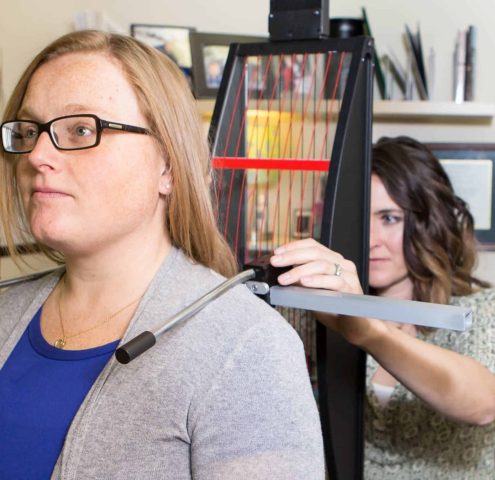
NUCCA is a precise, measurement-guided approach to upper cervical care that begins with detailed imaging of the atlas — its position, the compensation pattern it has created, and what that means specifically for your neck pain history. For people who have already tried a lot, that imaging often reveals a structural picture that none of their previous care had access to.
The correction itself is gentle. There's no cracking, no forceful manipulation, no rotation of the neck. The adjustment is applied by hand to the atlas with a degree of specificity that comes from reading the imaging carefully — not from force. Many patients remark that it feels almost unremarkable in the moment, which surprises them after years of more intensive manual therapies.
At Vibe Health and Spine, nothing is adjusted on the first visit until the structural picture is fully understood and discussed. That's not a formality — it's how NUCCA is meant to work. Precision at this level of the spine requires a complete picture first.
The changes people describe don't tend to arrive dramatically. What usually happens is quieter than that — and honestly, more meaningful.
The tension that used to return within two or three days of a massage takes a little longer to reassert itself. Then longer still. The neck that reliably tightened by Thursday starts making it through to Friday. The morning stiffness that had become such a familiar part of waking up begins to ease before it fades. Weekend hikes that used to cost two days of recovery through the upper back and neck start feeling like something the body can actually handle.
It doesn't all shift at once. But for people who have been managing this cycle for years — doing everything right and still not getting to the other side — that gradual change is something they recognize as genuinely different from temporary relief. And that difference tends to matter a great deal.
If you've done everything right and the neck pain keeps finding its way back, you haven't failed your care. The structural piece may simply have never been part of it.
At Vibe Health and Spine in Calgary, that's where we start — with a thorough conversation about your history, precise upper cervical imaging, and an honest look at what the structural findings mean for your specific situation. Nothing is adjusted until the picture is complete. No assumptions are made about what you've already tried or why it hasn't been enough.
Calgary winters are long and the demands on your body are real. The cycle you've been managing through all of it doesn't have to be permanent.
Schedule a consultation with the our Calgary chiropractors today to learn more about our approach.

1. I've had neck pain for years and physio always helps temporarily — why does it keep coming back?
That pattern — real relief that doesn't hold — is one of the clearest signs that the structural origin of the pain hasn't been reached yet. Physiotherapy works well on the muscular and mechanical consequences of atlas misalignment. But when the atlas stays in its misaligned position, it keeps recreating the same tension. The relief is genuine. The driver behind it just hasn't been part of the conversation.
2. My neck pain is always worse after physical activity — does that point to something structural?
It often does. When the atlas is misaligned, the neck muscles work harder than they should at baseline. Physical activity — hiking, skiing, cycling, the things patients in Calgary and nearby cities love — adds load to a structure that's already close to its limit. The activity reveals the vulnerability rather than creating it. An upper cervical assessment looks specifically at whether that vulnerability has a structural origin worth addressing.
3. My neck pain is mostly on one side — is that relevant?
Very much so. Atlas misalignment creates an inherently asymmetrical compensation pattern — loading the muscles on one side more heavily than the other. One-sided neck pain is one of the more common presentations we see in this context. That detail is worth bringing to your consultation at Vibe Health and Spine, because the imaging will assess exactly how the atlas position relates to the tension distribution you're experiencing.
4. Massage helps me for a few days but never holds — is something structural being missed?
Almost certainly. Massage releases muscular tension effectively — that benefit is real. But when the atlas is continuously recreating that tension from a structurally compromised position, the relief has a predictable ceiling. The structural driver that refills the tension within days is the piece massage was never designed to address. That's not a limitation of the massage — it's just where its scope ends.
5. Could my neck pain be connected to the headaches I get regularly?
Very possibly — and the two often share a structural origin at the upper cervical spine. The atlas influences both cervical muscle tension and the neurological environment that headaches develop in, which is why the two so often travel together. If both are part of your experience, bring that to your consultation. It adds meaningful context to the structural picture.
6. If I've had neck imaging before and it didn't show anything significant, does that mean upper cervical care isn't relevant for me?
Not necessarily. Standard cervical imaging — X-rays and MRI — is designed to identify disc pathology, fracture, stenosis, and significant degenerative change. It isn't calibrated to detect the precise positional misalignment of the atlas that NUCCA assessment examines. A patient can have entirely unremarkable standard imaging and still present with measurable atlas misalignment on upper cervical-specific views. The two assessments are looking at different things — and the absence of findings on one doesn't rule out findings on the other.
To schedule a consultation with Vibe Health and Spine, call our Calgary office at 587-803-3354. You can also click the button below.

If you are outside of the local area you can find an Upper Cervical Doctor near you at www.uppercervicalawareness.com.