403-266-2283
1918 Kensington Rd NW Unit #310, Calgary, AB T2N 3R5, Canada

Who This Blog Is For: If TMJ and neck pain have become a package deal for you — and the headaches, ear pressure, and shoulder tension that travel with them have started to feel like a symptom picture nobody has fully mapped — this was written for you. You came in looking for jaw pain relief and ended up managing something that seems to affect your entire upper body. This speaks to people across Calgary who have noticed that their TMJ goes well beyond the jaw, and who want to understand why.
You went to the dentist expecting a jaw problem. Maybe you got a night guard, some advice about jaw exercises, a suggestion to reduce stress. And the jaw settled — a little, sometimes — but the headaches kept coming. The neck stayed tight. The ear fullness comes and goes without warning. The tension that lives somewhere between your jaw and the base of your skull has become so familiar you’ve stopped mentioning it.
This is one of the most common and least-explained experiences of TMJ — the way symptoms spread. Patients who come to Vibe Health and Spine often describe feeling like their jaw problem quietly became a whole-body problem, and nobody along the way connected those dots for them. What follows is that connection — clearly, structurally, and honestly.
Table of Contents
Quick Answer: TMJ and neck pain, headaches, ear symptoms, and shoulder tension are connected through the body’s compensation chain. When the jaw joint is under chronic stress — often because the atlas is misaligned and the structural foundation is off — the surrounding muscles and joints adapt to protect it. That adaptation doesn’t stay local. It travels up into the head, down into the cervical spine, and across into the shoulders, creating a whole-body symptom picture that jaw-focused care alone was never designed to resolve.
The temporomandibular joint doesn’t operate in isolation. It sits within a structural system that includes the atlas, the cervical spine, the muscles of the head and neck, and the postural chain that runs the entire length of the body. When the atlas misaligns, the compensation pattern it creates affects the muscular balance on both sides of the jaw, alters the tension through the muscles that control jaw movement, and creates a cascade of postural adaptation that the TMJ absorbs chronically.
The result is a symptom picture that starts in the jaw and doesn’t stay there. The headaches that wrap from the jaw up into the temple. The neck tension that never fully releases no matter how often it’s worked on. The ear fullness or ringing that seems unrelated until you notice it always accompanies a TMJ flare. The shoulder that carries a permanent extra load on the same side as the tighter jaw. These aren’t separate problems. They are one compensation pattern expressing itself in multiple locations simultaneously.
When the atlas shifts out of optimal alignment, the body’s response is immediate and automatic — the entire postural chain adapts to keep the head level and the eyes on the horizon. That adaptation is intelligent in the short term and costly over time. Muscles on one side of the face and jaw work harder than the other. The cervical spine adjusts its curve. The shoulders compensate for the altered head position. The nervous system recalibrates around the new structural normal.
For TMJ patients, this spreading compensation is the explanation for the symptom picture that keeps expanding. The jaw is tight because it’s absorbing asymmetrical muscular load from above and below. The headaches are tension-type, driven by the suboccipital muscles — the deep muscles at the base of the skull — that have been working overtime to stabilize a head that isn’t sitting squarely on the spine. The ear fullness reflects the proximity of the TMJ to the structures of the inner ear, and the way altered joint mechanics in that region affect pressure and sensation.
Calgary’s desk-heavy professional population makes this pattern particularly common. Prolonged screen posture draws the head forward, adds load to the atlas compensation, and amplifies the muscular asymmetry driving the TMJ symptoms. By the time a patient arrives at Vibe Health and Spine, the original jaw problem has often been running long enough that the whole compensation chain has become deeply established.
Dental appliances, occlusal adjustments, and jaw physiotherapy are all thoughtful, well-intentioned approaches to TMJ — and we hold genuine respect for the providers who offer them. The limitation isn’t the quality of that care. It’s the scope of what any jaw-focused approach is designed to examine.
A night guard manages the loading on the joint during sleep — genuinely useful for reducing acute symptoms. It doesn’t assess whether the atlas is creating the muscular asymmetry that loads the joint in the first place. Jaw physiotherapy improves movement quality and muscular balance in the jaw — real and meaningful work. It doesn’t examine whether the structural foundation above and below the jaw is continuously recreating the imbalance being worked on.
When the symptom picture keeps expanding — when the neck tension and headaches persist despite jaw management, when the ear symptoms come and go regardless of how carefully the jaw is treated — it’s usually a signal that the structural origin of the whole pattern hasn’t been reached. The jaw is where the symptoms are most obvious. The atlas is frequently where the answer lives.
NUCCA care approaches TMJ differently from any jaw-focused intervention — because it doesn’t start with the jaw at all. It starts with the atlas, and the question of whether the structural foundation the jaw is operating within is part of what’s driving the symptom picture.
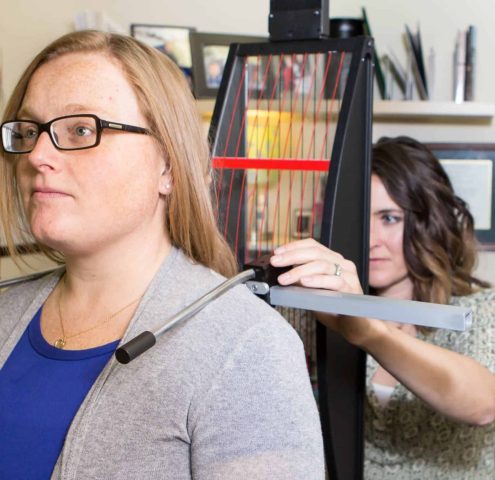
Before any correction is made at Vibe Health and Spine, detailed imaging of the upper cervical spine is taken — the precise position of the atlas, the compensation pattern it has established, and what that means structurally for the jaw, neck, and the broader symptom picture the patient has been living with. The correction itself is gentle. There is no cracking, no forceful manipulation, no rotation of the neck. It is applied by hand to the atlas with a specificity that comes entirely from reading the imaging carefully.
For patients who have spent years managing a TMJ symptom picture that keeps spreading, this process often produces a different kind of conversation than they’ve had before — one that maps their full experience rather than focusing exclusively on the joint. The whole-body nature of the symptom picture isn’t a complication at Vibe Health and Spine. It’s exactly what the assessment is designed to understand.
What patients describe as the atlas stabilizes and the compensation chain begins to reorganize tends to arrive in layers — and that layered quality is itself meaningful. The jaw tension that was always loudest often eases first. Then the headaches begin to space further apart. The neck releases in a way that feels structurally different from what massage produced — less like temporary relief and more like something has actually shifted. The ear fullness that came and went unpredictably becomes less frequent before it fades.
The shoulder that was always carrying extra tension on the tighter side quietly normalizes. Sleep improves — often earlier than patients expect — because the chronic muscular load that was driving nighttime clenching begins to reduce. For Calgary patients navigating demanding work weeks and long winters, those changes tend to register first in the practical texture of daily life: getting through a full day without the familiar jaw-to-temple tension, waking up without the neck already stiff, moving through the morning without the ear pressure that used to signal a difficult day ahead.
The whole-body symptom picture didn’t build overnight. It won’t resolve overnight. But when the structural foundation shifts, the whole pattern tends to respond — and that is something jaw-focused care alone was never positioned to deliver.
If your TMJ has always felt like more than a jaw problem — if it lives in your neck, your head, your ears, and your daily energy in ways that nobody has fully connected — the structural foundation may be the piece that’s been missing from every conversation you’ve had about it.
At Vibe Health and Spine in Calgary, that’s exactly where the assessment starts. A thorough consultation that maps your full symptom picture. Precise upper cervical imaging to assess the atlas and the compensation chain it has created. An honest conversation about what those findings mean for your specific experience — before anything is adjusted.
Your TMJ story is bigger than your jaw. The assessment at Vibe Health and Spine is designed to see all of it.
Schedule a consultation with our chiropractors to learn more about NUCCA in Calgary.

1. Why do I get headaches that seem to come from my jaw — are those actually TMJ headaches?
What most patients describe as TMJ headaches are tension-type headaches driven by the suboccipital muscles — the deep muscles at the base of the skull that become chronically overloaded when the jaw joint is under asymmetrical stress. Because those muscles attach close to the base of the skull and the temples, the headache that results often feels like it originates somewhere between the jaw and the top of the head. It’s the same compensation pattern expressing itself upward rather than laterally — and it responds to the same structural assessment.
2. My ear feels full or muffled on the same side as my worse jaw — is that a TMJ symptom?
Very likely yes. The temporomandibular joint sits in close anatomical proximity to the structures of the inner ear, and altered joint mechanics — particularly the kind driven by muscular asymmetry from atlas misalignment — can affect pressure, sensation, and even sound perception in the ear on the affected side. Ear fullness, muffled hearing, tinnitus, and a sensation of pressure that comes and goes are all reported TMJ-associated symptoms. If it consistently tracks with your jaw activity or flares, it belongs in your upper cervical consultation history.
3. I carry constant tension in one shoulder — could that be connected to my TMJ?
It can be, and the connection is through the compensation chain rather than through direct anatomical proximity. When the atlas misaligns and the TMJ absorbs asymmetrical muscular load on one side, the postural adaptation that follows distributes that asymmetry downward through the cervical spine and into the shoulder girdle. One shoulder working harder than the other as part of a whole-body compensation pattern is a common finding in patients with long-standing TMJ histories — particularly when the jaw tension is consistently worse on that same side.
4. I’ve been told my TMJ is stress-related — but I manage stress well and it hasn’t improved. What else could be driving it?
Stress is a genuine aggravator of TMJ — it increases clenching and muscular tension — but it is rarely the structural origin of the problem. When stress management hasn’t moved the needle, it usually means the underlying structural driver is still in place. The atlas compensation pattern that creates asymmetrical jaw loading runs independently of stress levels — it is a positional and mechanical issue that stress can worsen but that stress reduction alone cannot resolve. That structural piece is worth assessing directly.
5. Could my TMJ symptoms be related to a past neck or head injury I had years ago?
This is one of the most significant questions in an upper cervical consultation, and the answer is often yes. The atlas is particularly vulnerable to displacement from trauma — vehicle accidents, falls, sports impacts, and even significant birth trauma can establish an atlas misalignment that contributes to TMJ dysfunction years or decades later. The misalignment may have been subclinical for years before the cumulative load produced symptoms. Any significant head or neck injury in your history is worth describing in detail at your first visit.
6. Does the whole-body symptom picture make upper cervical care more complicated for TMJ patients?
Not more complicated — more complete. The whole-body symptom picture is actually useful clinical information. The pattern of where symptoms have spread, which side is worse, how the neck and jaw tension relate to each other, and how the headaches and ear symptoms track with jaw activity all inform the structural assessment at Vibe Health and Spine. Patients who present with the full picture often find that the imaging tells a clearer story than those whose symptoms have stayed more localized — because the compensation chain is more fully expressed and easier to read.
To schedule a consultation with Vibe Health and Spine, call our Calgary office at 587-803-3354. You can also click the button below.

If you are outside of the local area you can find an Upper Cervical Doctor near you at www.uppercervicalawareness.com.