403-266-2283
1918 Kensington Rd NW Unit #310, Calgary, AB T2N 3R5, Canada

Who This Blog Is For: If fibromyalgia and sleep problems have become your two most exhausting daily realities — and better sleep hygiene hasn’t changed the pattern — this was written for you. You’re not someone who hasn’t tried. You’re someone whose trying hasn’t reached the right layer yet. This speaks to people across Calgary who wake up every morning feeling like sleep never actually happened, and who are ready for a conversation that goes deeper than sleep tips.
You go to bed exhausted. You do everything right — the routine, the dark room, the consistent schedule. And somewhere around two or three in the morning you’re awake again, stiff through the shoulders and neck, pain already settling in before the day has started. By the time the alarm goes off you feel less rested than when you lay down.
If that cycle sounds familiar, you already know that fibromyalgia and sleep problems aren’t two separate issues happening to overlap. They feed each other in a loop that standard sleep advice was never really designed to break. What most people living with fibromyalgia are never told is that there may be a structural dimension to that loop — one that sits at the very top of the spine and influences the nervous system’s ability to settle into genuine rest. That’s what this blog is about.
Table of Contents
Quick Answer: Fibromyalgia and sleep problems are bidirectionally linked — poor sleep amplifies pain sensitivity, and chronic pain disrupts sleep quality, creating a self-reinforcing cycle. For many fibromyalgia patients, that cycle has a structural contributor that standard sleep assessments never examine: the position of the atlas and its influence on the neurological pathways governing nervous system arousal and restorative sleep. Addressing that structural foundation may help break the cycle from a level sleep hygiene alone can’t reach.
Fibromyalgia and sleep problems are inseparable for most people living with the condition. Research has consistently shown that poor sleep amplifies the central sensitization at the core of fibromyalgia — the nervous system becomes more reactive, pain thresholds drop, and the physical experience of the condition worsens measurably after a bad night. At the same time, fibromyalgia pain makes restful sleep genuinely difficult to achieve and maintain. The cycle runs in both directions simultaneously, which is part of what makes it so resistant to standard interventions.
What the standard sleep conversation rarely includes is a structural assessment of the upper cervical spine — specifically whether the atlas is contributing to the state of nervous system hyperarousal that keeps fibromyalgia patients from reaching the deep, restorative sleep stages their bodies need most. That structural dimension isn’t incidental to the sleep problem. For a meaningful number of patients, it may be central to it.
The mechanism worth understanding here is specific. Fibromyalgia is fundamentally a condition of central sensitization — the nervous system is amplified in its processing of pain signals, registering sensations as more intense than a non-sensitized system would. Sleep deprivation directly worsens that sensitization. Even one night of significantly disrupted sleep measurably lowers pain thresholds in healthy individuals. For someone whose nervous system is already sensitized, the effect is considerably more pronounced.
This means that every poor night’s sleep makes the fibromyalgia worse — which makes the next night’s sleep harder to achieve — which makes the sensitization worse still. The cycle compounds quietly over weeks and months until the baseline the patient is living from has shifted significantly from where it began. Many Calgary patients describe a gradual deterioration they can’t quite trace to a single cause, because the cause is the cycle itself running without interruption.
Breaking that cycle from the outside — through sleep aids, supplements, or behavioural routines — provides some relief at the symptomatic level. What it doesn’t address is whether a structural contributor has been keeping the nervous system in a state of chronic arousal that makes genuine rest physiologically harder to achieve in the first place.
Sleep hygiene recommendations — consistent sleep and wake times, limiting screen exposure before bed, managing caffeine, creating a cool and dark sleep environment — are genuinely evidence-based and worth maintaining. We’re not suggesting otherwise. The limitation isn’t that these approaches are wrong. It’s that they operate at the level of sleep behaviour, not sleep physiology.
When the nervous system is chronically hyperaroused — as it is in fibromyalgia, and potentially more so when atlas misalignment is adding structural stress to an already sensitized system — behavioural interventions can improve sleep conditions without resolving the underlying physiological barrier to deep rest. The room is dark, the schedule is consistent, the conditions are right. And the nervous system is still running too hot to settle into the slow-wave and restorative sleep stages the body depends on for pain regulation and tissue recovery.
Calgary winters compound this meaningfully. Short daylight hours disrupt circadian rhythm. Cold temperatures affect sleep quality independently. The physical demands of navigating winter add muscular tension that feeds directly into the hyperarousal pattern. For fibromyalgia patients already struggling with sleep, the seasonal shift in Calgary can push a manageable pattern into something significantly more disruptive — and the structural foundation underneath it becomes increasingly relevant.
The atlas sits at the craniocervical junction — one of the most neurologically significant regions of the spine. It is in close proximity to the structures involved in regulating autonomic nervous system tone, which governs the shift between the sympathetic arousal state and the parasympathetic rest state that genuine sleep requires. When the atlas misaligns, the chronic mechanical stress and altered nerve signaling that follows may keep the nervous system tilted toward arousal in ways the patient experiences as an inability to stay asleep, difficulty reaching deep sleep, or waking unrefreshed regardless of how many hours were spent in bed.
For fibromyalgia patients, whose nervous systems are already sensitized and whose pain thresholds are already compromised, that structural contribution to hyperarousal is not a minor variable. It may be one of the most significant factors in why the sleep-pain cycle has been so resistant to everything else that’s been tried.
This isn’t a claim that atlas misalignment causes fibromyalgia or its sleep disruption in isolation. It’s an observation that a structurally compromised upper cervical spine may be adding a meaningful layer of neurological stress to a system that was already struggling — and that removing that layer changes what the system is working with.
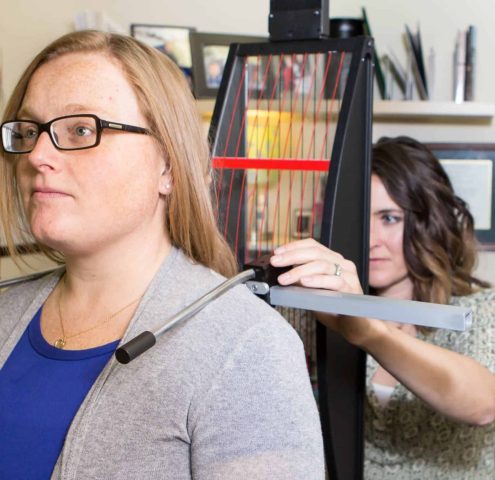
NUCCA care begins with detailed imaging of the upper cervical spine — the precise position of the atlas and the compensation pattern it has created. For fibromyalgia patients navigating sleep disruption, the gentleness of what follows is particularly relevant. The correction is applied by hand to the atlas with no cracking, no forceful manipulation, and no rotation of the neck. The adjustment is subtle in its physical delivery and precise in its structural intent.
For a nervous system that is already sensitized and hyperaroused, that gentleness is not just a comfort — it is a clinical consideration. The goal is to restore the structural foundation with as little additional disruption to an already taxed system as possible, creating the conditions for the nervous system to begin shifting toward a more regulated baseline.
At Vibe Health and Spine, the first visit involves a thorough consultation and full imaging review before any correction is considered. The team works from measurements, not assumptions — and for fibromyalgia patients with complex histories, that methodical approach is consistently described as one of the most reassuring aspects of the process.
Sleep changes are frequently among the earliest things fibromyalgia patients report as the atlas begins to stabilize — and this tends to come as a genuine surprise. Patients who expected pain to improve first often find that sleep quality shifts earlier in the process. They describe falling back to sleep more easily after waking in the night. Waking up with less neck and shoulder stiffness. Occasionally, for the first time in years, waking up feeling like sleep actually did something.
The pain changes tend to follow — not dramatically, but in the way the mornings feel, the way flares recover, the way the difficult days become slightly less difficult. For patients who have been managing a fibromyalgia and sleep problems cycle for years, those incremental shifts carry a weight that’s hard to overstate. They’re not just symptom improvements. They’re evidence that the baseline can actually change.
If you’ve been living with fibromyalgia and sleep problems for years — following every recommendation, maintaining every routine, and still waking up feeling like rest never quite landed — the structural layer may simply never have been part of the picture.
At Vibe Health and Spine in Calgary, that’s where the conversation begins. A thorough look at your full history, precise upper cervical imaging, and an honest discussion about what the structural findings mean for your specific sleep and pain pattern. Nothing is adjusted until the picture is complete. Find out if you're a candidate for upper cervical care for fibromyalgia in Calgary, AB.
Schedule a consultation with our Calgary chiropractors today to learn more about our approach.

1. Why do I wake up in more pain than when I went to bed — shouldn’t sleep be helping?
For fibromyalgia patients, waking in more pain than the night before usually means the body isn’t reaching the deep, slow-wave sleep stages where physical restoration actually happens. Non-restorative sleep — hours in bed without genuine rest — leaves the nervous system in an amplified state rather than a recovered one. The pain that greets you in the morning is often a direct reflection of how little restorative work the night actually did. When a structural contributor is keeping the nervous system in a state of arousal through the night, that pattern can persist regardless of how long you sleep.
2. What is non-restorative sleep and why does it matter so much in fibromyalgia?
Non-restorative sleep refers to sleep that doesn’t produce the physical and neurological recovery the body needs — you may be unconscious for eight hours and still wake exhausted. In fibromyalgia specifically, research has identified disruptions in slow-wave sleep — the deepest, most physically restorative stage — as a consistent feature of the condition. It’s during slow-wave sleep that the nervous system downregulates, pain-modulating processes run, and tissue recovery occurs. When that stage is chronically disrupted, the sensitization at the core of fibromyalgia goes unaddressed night after night.
3. Is there a link between the nervous system’s ability to regulate itself and how well a fibromyalgia patient sleeps?
Directly, yes. The autonomic nervous system governs the shift between sympathetic arousal — the alert, activated state — and parasympathetic rest, which is required for deep sleep. In fibromyalgia, the autonomic nervous system is frequently dysregulated, tilting toward chronic sympathetic dominance. The atlas and surrounding upper cervical structures sit in close proximity to the neurological pathways involved in that regulation. When the atlas is misaligned and those pathways are under chronic mechanical stress, the nervous system’s ability to make the shift into genuine rest may be compromised at a physiological level that no behavioural intervention can fully reach.
5. I’ve tried sleep supplements and nothing has made a lasting difference — does that mean the problem is structural?
Not necessarily on its own — but it’s a meaningful data point. Sleep supplements address the neurochemical side of sleep onset and maintenance. When they provide only temporary or partial benefit for a fibromyalgia patient, it suggests the barrier to restorative sleep may not be primarily chemical. A structural assessment of the upper cervical spine examines a dimension that supplements, sleep hygiene, and most other sleep interventions were never designed to address. Whether that dimension is relevant for you specifically is what the assessment at Vibe Health and Spine is designed to determine.
6. If my fibromyalgia sleep problems improve with upper cervical care, will the pain improve too?
For many patients, the two are connected closely enough that improvement in one tends to reflect in the other — because the sleep-pain cycle runs bidirectionally. Better sleep reduces the nervous system sensitization that amplifies pain. Reduced pain makes sleep easier to achieve and maintain. As the atlas stabilizes and the structural stress on the nervous system decreases, both dimensions of the cycle tend to shift — though the timeline and the sequence vary meaningfully from person to person. Sleep quality improving before pain intensity is a pattern we see often, and it’s worth knowing to expect.
To schedule a consultation with Vibe Health and Spine, call our Calgary office at 587-803-3354. You can also click the button below.

If you are outside of the local area you can find an Upper Cervical Doctor near you at www.uppercervicalawareness.com.