403-266-2283
1918 Kensington Rd NW Unit #310, Calgary, AB T2N 3R5, Canada

Who This Blog is For: Anyone in Calgary who has been living with a fibromyalgia diagnosis and has always noticed that the neck is where the pain lives loudest. This is for the person who has done the research, seen the specialists, and followed the recommended path — and still wakes up every morning wondering why the baseline never really improves. If the structural relationship between fibromyalgia and neck pain has never been formally explored as part of your care, that gap may be more significant than anyone has acknowledged.
Do you carry a near-constant ache through your neck and shoulders that no amount of rest, stretching, or careful management ever fully resolves? Have you noticed that your fibromyalgia flares almost always seem to start — or feel worst — in the cervical region, even when the pain eventually spreads elsewhere? Have you ever wondered whether the widespread sensitivity your body experiences might be connected to something structural that has simply never been assessed?
These are the questions we hear most often from Calgary patients who arrive at Vibe Health and Spine having navigated years of fibromyalgia management without the structural piece ever entering the conversation.
Fibromyalgia is a real, complex, and genuinely debilitating condition — and it is also one that is almost never evaluated in the context of upper cervical alignment. For a meaningful number of patients, that missing layer changes the picture considerably.
Table of Contents
Fibromyalgia and neck pain are so consistently linked that cervical tenderness is among the most frequently reported features of the condition. For most patients that connection is noted and managed — but rarely explained structurally. What upper cervical care brings to the conversation is a specific and assessable mechanism: the position of the atlas and the compensation pattern it creates throughout the spine and nervous system.
The atlas sits at the craniocervical junction — the most neurologically significant region of the spine — where it influences muscle tension, nerve signaling, and the regulatory pathways that govern how the entire nervous system processes sensation. When the atlas misaligns, the compensation pattern it creates places chronic mechanical stress on the structures in that region and alters the baseline tone of the nervous system in ways that are directly relevant to how fibromyalgia symptoms develop and persist.
Fibromyalgia is fundamentally a condition of central sensitization — the nervous system becomes amplified in its pain response, registering sensations as painful that would not register that way in a non-sensitized system. A structurally compromised upper cervical spine may not cause that sensitization, but the chronic mechanical stress and altered nerve signaling it produces can contribute meaningfully to maintaining and amplifying it. The neck pain fibromyalgia patients carry is frequently both a symptom of the condition and a signal of something structural that deserves its own assessment.
We want to be clear about something that matters for this conversation: upper cervical care does not claim to resolve fibromyalgia. What it addresses is whether a structural compensation pattern is adding a layer of neurological stress on top of an already sensitized system — and whether removing that layer changes the baseline the patient is living from.
When the atlas shifts out of optimal position, the suboccipital muscles — the deep muscles at the base of the skull — work asymmetrically and chronically to stabilize the head. That constant muscular effort produces a low-grade but persistent state of tension that feeds directly into the sensitized nervous system of a fibromyalgia patient. Flares that appear to arrive without warning often have a cumulative structural trigger underneath them — the nervous system reaching a threshold that the atlas compensation pattern has been quietly pushing it toward.
Calgary's seasonal transitions — the abrupt temperature drops, the Chinook pressure swings, the physical demands of navigating winter — create an environment where that structural vulnerability becomes particularly costly. Patients who already manage a sensitized nervous system find that those environmental stressors land harder when the structural foundation is compromised. Stabilizing the atlas doesn't eliminate fibromyalgia, but it may meaningfully reduce the amplification effect that has been making the condition harder to manage than it needs to be.
Fibromyalgia care appropriately lives within rheumatology, neurology, and primary care — and the providers working within those disciplines are doing exactly what their training and scope equip them to do. The structural dimension of upper cervical alignment simply isn't part of a standard fibromyalgia workup, not because it's been considered and dismissed, but because it sits outside the diagnostic framework those assessments are built around.
This means that a patient can move through years of responsible, well-intentioned fibromyalgia care — medication adjustments, physiotherapy, sleep management, pain psychology — without anyone ever asking whether the top of the spine is contributing to the nervous system environment those approaches are trying to regulate. The care isn't incomplete by any individual provider's failing. The structural layer is simply absent from the standard pathway.
For patients whose fibromyalgia has always featured prominent neck pain and tension, that absence is worth addressing directly. Upper cervical care at Vibe Health and Spine doesn't replace the fibromyalgia management already in place — it adds a structural assessment that has been missing from the picture.
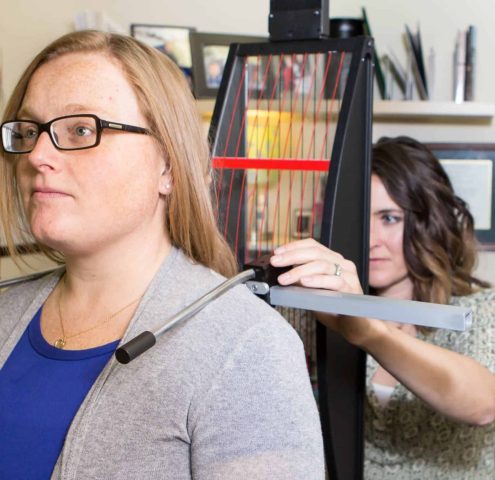
NUCCA care begins with detailed imaging of the upper cervical spine — specifically the position of the atlas relative to the skull and the vertebra below it. For fibromyalgia patients, this imaging process is particularly important because the gentleness and precision of what follows depends entirely on understanding the structural picture clearly before anything is done.
The NUCCA correction is applied by hand to the atlas with no cracking, no forceful manipulation, and no rotation of the neck. For a patient whose nervous system is already sensitized, that gentleness is not incidental — it is a defining feature of why NUCCA is particularly well suited to this patient population. The goal is to restore the structural foundation with the least possible disruption, allowing the nervous system to begin adapting from a more stable base.
At Vibe Health and Spine, the first visit involves a thorough consultation and imaging review — no correction is made until the structural findings have been fully assessed and discussed. The team works from measurements and takes a methodical approach that fibromyalgia patients, many of whom have had difficult experiences with forceful manual therapies, consistently describe as a meaningful departure from what they expected.
The changes fibromyalgia patients describe as the atlas stabilizes tend to be quieter than dramatic — and we think that honesty is important to offer upfront. This is not a condition that resolves quickly, and upper cervical care does not claim otherwise. What patients more commonly report is a gradual shift in the baseline they've been living from.
The neck tension that was always loudest begins to ease in a way that feels structurally different from temporary relief. Sleep quality frequently improves earlier in the process than patients expect — likely because the chronic suboccipital tension driving nighttime hyperarousal begins to reduce. Flares that previously arrived with little warning start to feel more manageable, their intensity lower and their recovery shorter.
For Calgary patients managing fibromyalgia through demanding work schedules, long commutes, and the physical toll of harsh winters, that baseline shift often registers first in the small daily measures — waking up with less neck stiffness, moving through the day with marginally less effort, finding that the difficult days are slightly less difficult. Those incremental changes, for patients who have been managing a sensitized system for years, are often profoundly meaningful.
If you have been living with fibromyalgia for years and the neck has always been the loudest part of the picture, the most important question may be one that has never formally been asked: is there a structural layer contributing to what you're carrying — and has anyone ever looked?
At Vibe Health and Spine in Calgary, that is exactly where the assessment begins. A thorough consultation covering your full history, precise upper cervical imaging, and an honest conversation about what the structural findings mean for your specific pattern. No correction is made until the picture is complete. No assumptions are made about what you've already tried or why it hasn't been enough.
Fibromyalgia is hard enough on its own. The structural amplification that may be sitting underneath it doesn't have to remain unaddressed.
Schedule your consultation at Vibe Health and Spine today.

1. I've had fibromyalgia for years and the neck pain is always the worst part — why has no one looked at my spine structurally?
This is one of the most common frustrations we hear, and it has a straightforward explanation. Fibromyalgia care sits within rheumatology and primary care — disciplines whose assessment frameworks don't routinely include upper cervical structural evaluation. It's not that the connection has been considered and ruled out. It simply hasn't been part of the standard pathway. An upper cervical assessment at Vibe Health and Spine looks specifically at what those standard assessments were designed to examine.
2. My fibromyalgia flares seem to come out of nowhere — could there be a structural trigger I'm not recognizing?
Flares that feel random often have cumulative triggers underneath them — the nervous system reaching a threshold that has been building gradually. When atlas misalignment is contributing to chronic mechanical stress and altered nerve signaling, that structural pressure can function as a persistent background trigger that lowers the threshold for flares significantly. Patients frequently report that once the structural pattern begins to stabilize, flares become less frequent and more predictable — which makes them meaningfully easier to manage.
3. I'm already sensitive to touch and manual therapy — is NUCCA care appropriate for me?
This is one of the reasons NUCCA is particularly well suited to fibromyalgia patients. The correction is gentle — applied by hand to the atlas with no cracking, no forceful manipulation, and no rotation of the neck. Many fibromyalgia patients who have had difficult experiences with more forceful manual therapies describe the NUCCA process as genuinely different in that respect. The team at Vibe Health and Spine takes the time to understand your sensitivity history before any care begins.
4. My sleep is severely disrupted by fibromyalgia — could upper cervical care have any relevance to that?
Sleep disruption in fibromyalgia is closely tied to the chronic hyperarousal state of a sensitized nervous system — and the upper cervical spine plays a direct role in the neurological environment that either supports or undermines that regulation. Patients receiving NUCCA care at Vibe Health and Spine frequently report that sleep quality is among the first things to begin improving as the atlas stabilizes, likely because the chronic suboccipital tension contributing to nighttime hyperarousal starts to ease. It's a connection worth exploring.
5. I've been told fibromyalgia has no structural cause — does that mean upper cervical care won't help?
Fibromyalgia's primary mechanism is central sensitization — a neurological process, not a structural one — and that framing is accurate. What upper cervical care addresses is not the sensitization itself but whether a structural compensation pattern is amplifying it. Those are two different questions. The atlas assessment at Vibe Health and Spine examines whether a structural contributor has been adding to the load your nervous system is already carrying — and whether addressing it changes your baseline.
6. What should I bring to my first visit at Vibe Health and Spine if I'm coming in for fibromyalgia and neck pain?
Bring whatever documentation you have — diagnosis history, previous imaging, a list of what you've tried and how each approach affected your symptoms. The consultation at Vibe Health and Spine is thorough, and the more your full history is understood upfront, the more meaningful the structural findings become in context. Come prepared to describe your neck pain specifically — where it lives, when it's worst, and how it relates to your broader fibromyalgia experience. That detail matters for the assessment.
To schedule a consultation with Vibe Health and Spine, call our Calgary office at 587-803-3354. You can also click the button below.

If you are outside of the local area you can find an Upper Cervical Doctor near you at www.uppercervicalawareness.com.